
TWIST BIOREGIONAL WORKSTREAM
The TWIST Bioregional Workstream explores how investing for systems change can be rooted more deeply in place, aligning capital with the ecological, cultural, and social systems that sustain life. It brings together practitioners, investors, and community leaders who are connected to a Place and actively explore bioregional approaches to finance, governance, and collaboration. Rather than offering a fixed model, the workstream is a space for collaboration, shared learning and field-building.

A Shift Toward Place-Based Systems Change
Across the TWIST community, there is a growing recognition that lasting systems change cannot be achieved through abstract, disconnected interventions. Instead, it must emerge from the living dynamics of specific landscapes and communities.
The bioregional workstream supports this shift by asking:
How can capital be mobilised in ways that regenerate ecosystems and communities?
What does it mean to invest with a place, rather than into it?
How can financial systems reflect the complexity of real-world systems?
The Bioregional Working Group
Launched in early 2026, TWIST Bioregional Working Group convenes members of our Ecosystem who are funding bioregional portfolios or building the infrastructure for place-based initiatives. Through learning series and shared resources, we are exploring and gaining insights on how investors, communities, and ecosystems might support this work.
2025 Report: “Bioregioning for Systems Change”
Our 2025 exploratory report captures these early learnings from conversations we held with some of our TWIST community members who are actively engaging in bioregional efforts , serving as a directional map for what questions and areas to explore as a community.
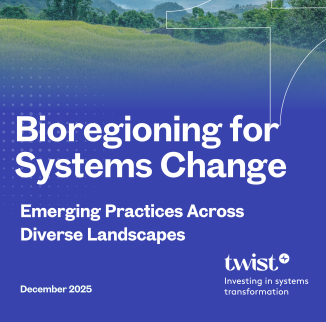
Report “Bioregioning for Systems Change - Emering Practices Across Diverse Landscapes” (2025)
Join the TWIST Bioregional Workstream
If you are designing or funding bioregional portfolios, leading place-based initiatives, or building the governance, capital, and learning infrastructures that enable regenerative practice, we invite you to enrol in the Bioregional Working Group. By completing the form, you will help us understand who is in the room and shape future sessions around the questions and challenges you are navigating.
Once you complete the participation form, you’ll receive:
Calendar invites and Zoom details for upcoming sessions;
Access to session materials;
Invitations to future practitioner-focused conversations.
For specific questions and clarification about the Workstream, you can also reach out directly to Maria Balcazar Tellez.